
Munroe Island: A Living Poem on the Edge of Time
- harish segon

- May 4
- 7 min read

In Kerala, Munroe islands are slowly sinking. Scientists believe that these magical islands may totally vanish in next three decades. The islands are nature’s gift to man and sadly nature has decided to take them back. As a matter of fact, two of the eight islands are already sinking and wear a deserted look. Climate change researchers call it, “India’s first sinking island.”
We had come for rest and relaxation but what we found was a living poem—fragile, luminous, and trembling against time. My wife and myself recently visited this place in Kollam district. It has everything, river & lake and sea in the background. We were blessed to stay at the confluence of river & lake and rightly name of the place was Lake River resort.
It was early morning next day, when we stepped onto the wooden country boat from the banks of Ashtamudi Lake. The lake, whose name means “eight coned,” unfolded like a silver palm under the rising sun. Frankly speaking, we had come to this place in Kollam district for rest and relaxation but what we found was a living poem—fragile, luminous, and trembling against time.
Our boatman called it “Munroethuruthu,” rolling the Malayalam syllables with reverence, as if he was naming a deity rather than a cluster of eight small islands stitched together by canals.
The boat glided through narrow canals barely wider than its own body. Coconut palms leaned inward as though sharing secrets. Their long leaves brushed the surface, sketching trembling reflections. The soft sound of oars cutting through waters with occasional call of birds perched on the trees, gave solace.
Drifting through mangroves, walking barefoot in cold water or watching the sunset, reflecting its rays on backwaters or lake was mesmerising. Watching these serene natural phenomenon, I realised how rare and special this orchestra of silence is.
Egrets stood like meditating ascetics. The air smelled of wet earth and toddy, of fish and hibiscus, of something ancient and tender. I felt as if I had slipped between pages of history to forgotten time.
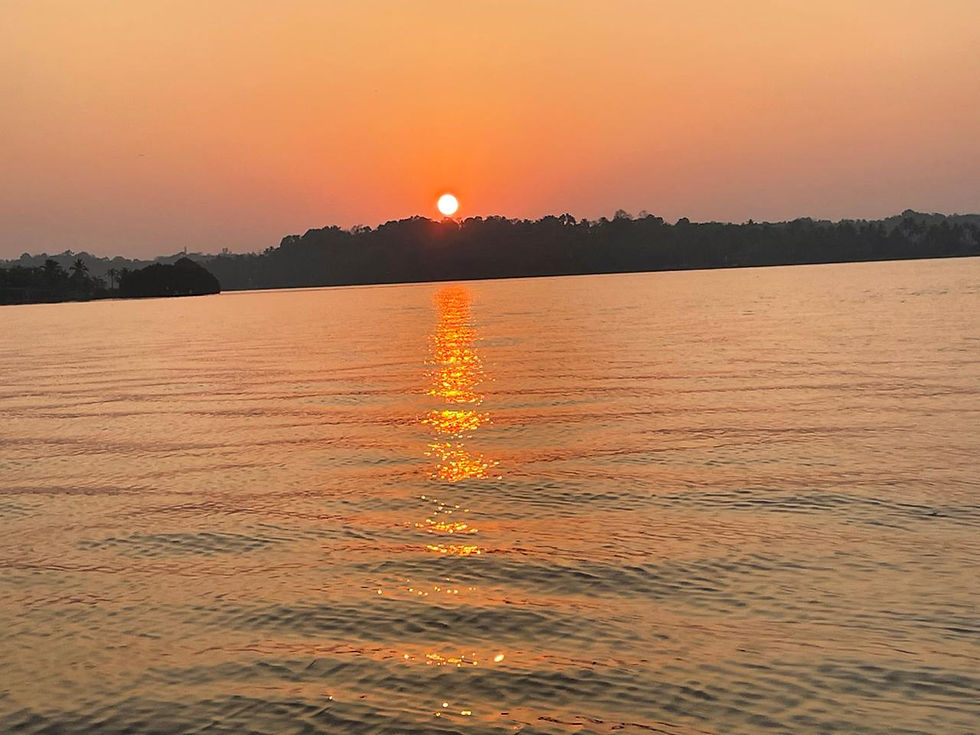
As our boat reached middle of the lake, our boatman slowly manoeuvred boat eastwards and pointed beyond swaying coconut palm trees. It was a magnificent site with horizon turning pink and sun appearing from behind the palms in all its glory. Believe me, I had never seen sunrise so glorious in my life. The sun was now a perfect round ball of red with its golden rays simmering on the blue waters of placid lake weaving subtle patterns.
Another interesting site was watching a kingfisher fly high above the lake, select his prey and then dive with perfection to pick up a fish, his meal for breakfast.

As our boat entered backwaters, our boatman pointed out medicinal plants growing wild along the banks—brahmi creeping low, wild turmeric hiding shyly beneath broad leaves. He spoke of migratory birds that visit during winter, of otters occasionally sighted at dawn, of fish that shimmer like quicksilver beneath the surface. In that fragile dawn, Munroe Island seemed eternal.
I thought of the intricate relationship between land and water here. The canals were not mere waterways; they were lifelines—used for transport, fishing, irrigation, and daily chores. The houses faced the water. Boats were parked like cars. Even conversations drifted across canals from veranda to veranda.
As we drifted deeper, I noticed homes perched barely above water level. They were modest—lime-washed walls, red-tiled roofs, small verandas adorned with drying fish and coir ropes. Children waved from wooden jetties. Women washed utensils at the steps leading into the canal, their sarees tucked neatly, laughter echoing across the water. Every movement was in rhythm with the tides.
I disembarked near a narrow bund and walked along a path that seemed to float. On either side were paddy fields, some below sea level, protected by mud embankments. I learned that farming here was an act of courage. The soil, rich with silt from the Kallada River, once yielded bountiful harvests of rice and coconut. But rising water levels and saltwater intrusion had begun to wound these fields. Climate change was no abstract debate here; it showed at doorsteps.
An elderly man invited me into his courtyard. His palms were rough from years of coir-making. He showed me how coconut husks were retted in the canals, soaked for months until the fibers loosened. The fibers were then spun into ropes—strong, resilient, smelling faintly of brine. Coir had once been the pride of Kollam, exported across oceans. Now, cheaper synthetic alternatives threatened this tradition.
By noon, the sun turned fierce, yet the breeze from the lake softened its edge. I climbed a small wooden bridge arching over a canal and looked out at the vast stretch of Ashtamudi. The backwaters shimmered like molten glass. Canoes cut gentle ripples. The horizon blurred into coconut groves and distant church spires. Somewhere, a temple bell chimed, answered by the faint call to prayer from a mosque. Faith here did not compete; it coexisted like currents merging quietly.
Munroe Island’s geography is delicate. It lies barely a few feet above sea level. Tides dictate daily life. During monsoon, the waters swell, sometimes flooding homes. In recent years, residents have spoken of land subsidence—of earth sinking gradually, invisibly. Scientific studies have linked this to sand mining in the Kallada River and upstream dam constructions that alter sediment flow. The land that once rose confidently now seemed to sigh under invisible pressure.
Yet beauty persisted, defiant and luminous.
In the evening next day, we opted for shikara ride through pristine Kollada river with cool breeze caressing our face. The sky began its slow metamorphosis. Orange bled into pink, then into a bruised purple. Coconut silhouettes stood etched against the fading light. The water mirrored the sky so perfectly that for a moment I felt suspended between two heavens.
I dipped my fingers into the canal. It was cool, alive. Tiny ripples radiated outward, distorting the reflection of my own face. I thought of how many generations had done the same—fishermen checking nets, children learning to swim, lovers whispering under moonlight. The water carried stories in its currents.
Midway, our guide pointed towards two dogs swimming across the river. They were heading towards other bank for their meals. Their master had shifted home to this bank some time ago. Dogs stayed back in old deserted home and swam across river to the other bank twice a day for meals. What a fine example of loyalty of dogs to the master and their emotional attachment to old home.
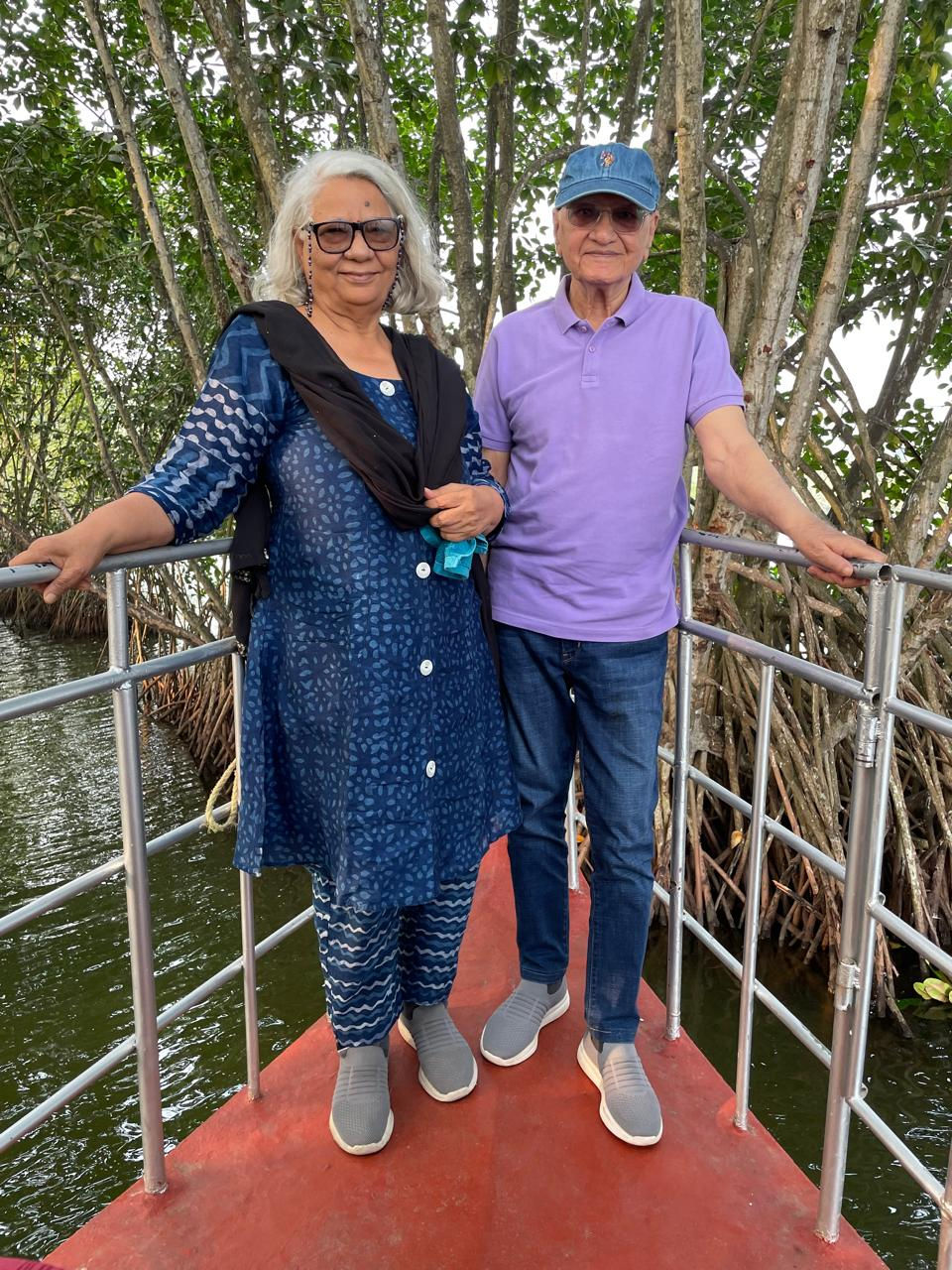
Our guide slowly halted shikara before mangroves, an added attraction of the region. We got down from shikara in knee deep cold water and touched mangroves which are said to be strong enough to withstand ferocity of a Tsunami.
It was now time for sublime sunset. The sky began its slow metamorphosis. Orange bled into pink, then into a bruised purple. Coconut silhouettes stood etched against the fading light. The water mirrored the sky so perfectly that for a moment I felt suspended between two heavens.
Night on Munroe Island is not loud. It hums. Crickets begin their chorus. Distant oars slap rhythmically. The smell of wood smoke drifts through the air.
Dinner at our resort was simple and unforgettable: karimeen fried crisp, tapioca steamed soft, and a curry fragrant with coconut milk and curry leaves. The fish had come from the very waters I had touched hours earlier.
As we ate, our manager at the resort, Himani spoke of the island’s inclusion in responsible tourism initiatives by the Kerala government. Efforts were being made to promote eco-friendly canoe tours instead of motorboats, to reduce plastic waste, to encourage homestays that benefit local families directly. Tourism, if gentle, could become a lifeline.
But there was fear too.
“Some islands are shrinking,” she said quietly. “During heavy rains, water enters houses.
Residents raise floors again and again. How long can they keep raising them?”
The resort manager was compassionate, kind and good at her work. On Valentines night, she arranged dinner for us right on the bank of Ashtamudi lake. A special table was laid for us with colourful balloons tied between coconut trees. Lake formed the backdrop with ghazals and old songs adding romantic tinge to the atmosphere. The entire staff presented us Valentine’s Day greetings card. It was an emotional moment which made this day special for us.

Munroe Island is not dramatic in the way mountains are dramatic. It does not overwhelm with scale. Its drama lies in subtlety—in the way light shifts on water, in the resilience of people who build and rebuild, in the silent negotiation between tide and soil.
As my boat pulled away on the final evening, I noticed sky turning crimson, reflecting its colours in the vast mirror of Ashtamudi Lake. For a fleeting second, island and reflection merged into one continuous tapestry of color.
I realized then that Munroe Island is not merely a destination. It is a threshold—a place where land learns humility from water, and where humans learn both gratitude and fear from nature’s generosity.
The only sound was the oar slicing through liquid gold.
And in that sound, I heard a promise and a plea intertwined—the promise of beauty that endures, and the plea of a fragile world asking to be cherished before it sinks quietly into memory.
Munro islands abound in natural beauty and have a mystical aura around them. It is a perfect place for those who love peace and solitude. Our cosy little resort was perfect place for laid back relaxation as well as meditation to be one with god. Flora & Fauna was at its best with lake and river enhancing charm of the place. We even enjoyed a perfect sunset view from our room balcony.
Thank god that we chose Munro islands over Alleppey which was our first choice.
Munro islands total area is 13.37 sq. Km. It represents a blend of colonial administrative brilliance & ancient maritime culture of Kerala. It is named after John Munro, a Scotsman, who served as British resident of erstwhile Travancore state from 1810 to 1819. The place name evolved to Munroe Island.

Munro saw potential of this marshy waterlogged area and decided to reclaim the land. Canals were dug to drain water from land and provide transport network and interconnected for navigation through boats. Munro was known as rice bowl of the region and also for its fertility and biodiversity. Main crops were coconut, paddy, cloves tubers and fish.
Since 2004 Tsunami, the islands have been experiencing a phenomenon known as “Land Subsidence”. Due to rapid environmental changes, parts of islands are sinking, due to rising sea levels & construction of Kollada river dam, which stopped silt deposit. Munroe Island is not merely a destination. It is a threshold. A promise of beauty that endures, and a plea of a fragile world asking to be cherished before it sinks quietly into memory.


Comments